

A Brief History
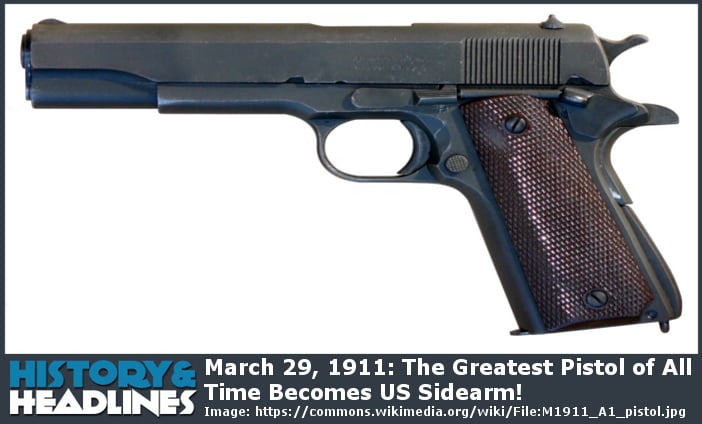
On March 29, 1911, the US Army made the Colt M1911 .45 caliber semi-automatic pistol its official sidearm. (For a companion list for this article, please see our list of “The Top 10 Famous Pistols.”)
Digging Deeper
The late 19th century and early 20th century represent an exciting time in history of firearms, with inventors and manufacturers racing each other to produce rugged and reliable semi-automatic sidearms for the lucrative military market.

The US Army had previously discovered their .38 caliber revolvers did not have the stopping power needed to halt an enthusiastic or even drugged enemy while fighting the Moros in the Philippines, and had brought their old Colt Peacemaker single action .45’s back into service. Bulky and slow to reload, something more modern was needed, and the Army wanted that something launching man stopper bullets!
A 1904 study of bullet effectiveness further sold the US Army on the choice of a .45 caliber pistol, and the rapid reloading capability of semi-automatic pistols definitely favored that design. Many other of the new semi-autos being presented at the time were deemed of insufficient caliber, frequently .32 (7.65 mm) or .36 (9 mm). (Note: caliber is the diameter of the projectile/bullet in hundredths of inches, thus a .50 caliber bullet is ½ inch wide. Caliber is frequently also expressed in millimeters.)

The John Browning designed entry from Colt was tested against other entries from Luger and Savage, all in .45 caliber, with the Colt coming out on top by a large margin. Rugged, incredibly reliable, quick to reload, and easy to disassemble and reassemble without tools for cleaning and maintenance made the M1911 the clear winner.
Serving in World War I, the M1911 was modestly improved in 1924 and designated M1911A1.

Serving all branches of the US armed forces as well as various law enforcement agencies, the M1911A1 continued as the main US combat pistol through World War II and the Viet Nam War, until 1985 when the 9 mm Beretta M9 (model 92) became the primary US military pistol. The Colt .45 was not done!
Continued use in special units of the military never ended for “Old Slabsides” and an updated version featuring an accessory rail has been designed for the Marine Corps. Many pistoleros consider the 1911 as the ideal pistol design that has not yet been beaten! Imitations from numerous countries and companies have been and are being produced, and slightly smaller models such as the Officer’s Model and the Commander have been made. A magazine holding 7 or 8 rounds, plus 1 in the chamber sounds good compared to the old six-shooter revolvers, but is a lot less than the 15 to 20 rounds carried by today’s “wonder nines” 9mm pistols. The .45 ACP (Automatic Colt Pistol) bullet weighs in at 230 grains, compared to 115 grains for standard 9 mm bullets, so the 1911 actually holds as much weight in ammo as the newer guns. (Just to keep everybody happy, the 1911 has been produced in a variety of calibers other than .45, but not for US military service.)

The main complaint against the M1911/M1911A1 has been the pathetic military sights, and you really do not find those on new production guns. Untold thousands, or even millions of service men and women have carried the 1911 with the confidence of knowing it would do the job!
Question for students (and subscribers) to ponder: If you could carry any pistol in combat, what would it be?
If you liked this article and would like to receive notification of new articles, please feel welcome to subscribe to History and Headlines by liking us on Facebook and becoming one of our patrons!
Your readership is much appreciated!
Historical Evidence
For more information, please see…
Poyer, Joe. The Model 1911 and Model 1911A1 Military and Commercial Pistols (For Collectors Only). North Cape Publications, Inc., 2017.
Sweeney, Patrick. 1911 The First 100 Years. Gun Digest Books, 2010.
The featured image in this article, a photograph by M62 of a M1911 A1 pistol in .45 ACP by Remington, is licensed under the Creative Commons Attribution-Share Alike 3.0 Unported, 2.5 Generic, 2.0 Generic and 1.0 Generic license.
You can also watch a video version of this article on YouTube: