

A Brief History
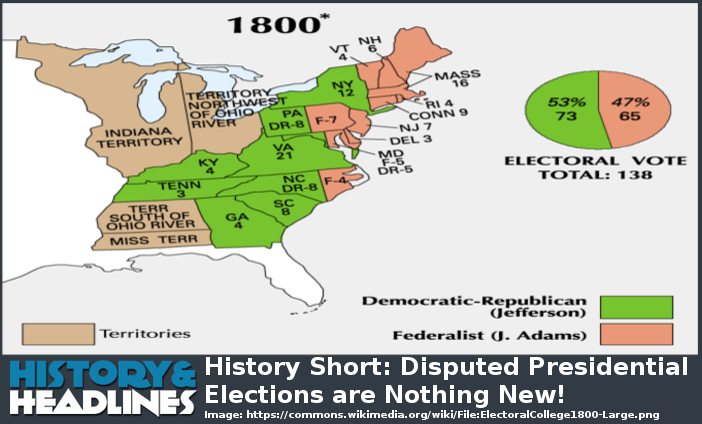
On December 3, 1800, the Electoral College tallied votes in the Presidential election and found the two main contenders, Thomas Jefferson and Aaron Burr, were tied. Incredible though it seems today, Burr was actually the Vice Presidential running mate of Jefferson that year, but Electoral rules at the time allowed each elector to vote for two people, the second highest vote getter becoming Vice President.
Digging Deeper
Jefferson and Burr beat incumbent John Adams, and a special election in the House of Representatives was held to pick a winner between Jefferson and Burr. Jefferson won that vote, 10 states to 4 for Burr.
In 1824, the Presidential election also went to the House, as no candidate received a majority of Electoral votes. Andrew Jackson received the most popular and Electoral votes, but a runoff was held between Jackson and runner-up JQ Adams. Adams won the House vote, 13 states to 7 for Jackson, and 4 for William Crawford.
Question for students (and subscribers) to ponder: Who is your favorite President?
If you liked this article and would like to receive notification of new articles, please feel welcome to subscribe to History and Headlines by liking us on Facebook and becoming one of our patrons!
Your readership is much appreciated!
Historical Evidence
For more information, please see…
Callahan, David. The Politics of Corruption: The Election of 1824 and the Making of Presidents in Jacksonian America. University of Virginia Press, 2022.
Larson, Edward. A Magnificent Catastrophe: The Tumultuous Election of 1800, America’s First Presidential Campaign. Free Press, 2008.
The featured image in this article, an 1800 U.S. presidential election map, was obtained from an edition of the National Atlas of the United States. Like almost all works of the U.S. federal government, works from the National Atlas are in the public domain in the United States.
You can also watch video versions of this article on YouTube.