

A Brief History
On October 19, 1950, the worst fears of President Truman came true, when despite General Douglas MacArthur’s confident assessment that the Chinese would not cross the Yalu River and interfere with the Korean War, 200,000 Chinese soldiers streamed across the river and attacked UN/South Korean forces. MacArthur had told Truman only about 100,000 Chinese soldiers were near the Yalu, a gross underestimate. Even after initial fighting with Chinese, MacArthur did not grasp the scope of the disaster.
Digging Deeper
North Korea had invaded South Korea earlier that year, surprising the US and its South Korean ally. Korea had been split in 2 after World War II, with the North (above the 38 Parallel) being communist and aligned with the USSR and Red China, and the South maintaining a capitalist democracy aligned with the West.
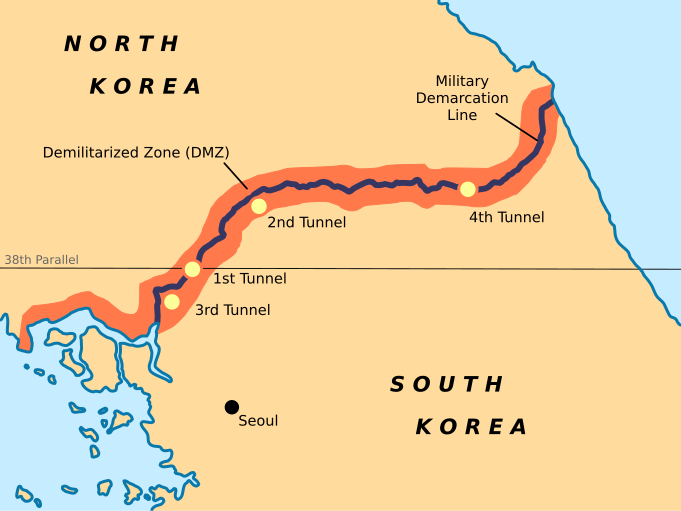
North Korean forces steamrolled across South Korea, nearly taking over the entire country and kicking the Americans off the peninsula before US Army troops aided by air cover from aircraft carriers and Air Force planes stationed in Japan finally halted the North’s advance at the Pusan perimeter. General MacArthur, US Army legend and legend in his own mind as well took command and conducted a brilliant campaign of envelopment by sea by landing Marines at Inchon. United Nations forces (mainly US and South Korean) proceeded to beat back the North Koreans across the border (38th Parallel) almost to the Chinese border.
With Soviet dictator Josef Stalin’s urging, Chairman Mao of China authorized his army to intervene on behalf of their North Korean allies, and the unprepared Americans were pushed back deep into South Korea once again. General MacArthur threatened the destruction of China, seen as a threat to use nuclear weapons, and demanded an enormous increase in US forces along with permission to invade China. MacArthur’s blunder, disrespect of President Truman, and the military reverses led to his dismissal in April of 1951 and the appointment of Lt. General Matthew Ridgway as American commander.

The US and ROK (Republic of Korea, or South Korea) forces rallied again and a stalemate developed until an armistice/cease fire was arranged in 1953. Unfortunately, a peace treaty was never signed and the lack of fighting has been a tense respite ever since, the threat of a resumption of hostilities hanging over the Korean peninsula to this day.
Chinese intervention cost in the area of 400,000 Chinese “volunteers” dead and another 400,000+ wounded, according to Western sources. Overall, more than a million people died on all sides. Of course, China claimed fewer casualties, but the human investment was enormous either way. At least Truman’s cool head kept the casualties on both sides from stratospheric dimensions had Douglas MacArthur gotten his way and World War III been started, quite possibly a nuclear war on both sides, perhaps spilling over into Europe.

Question for students (and subscribers) to ponder: Was MacArthur right after all, and should Truman have let him have his way with North Korea and China? Obviously, our general opinion is that Truman was right, but do you think otherwise?
If you liked this article and would like to receive notification of new articles, please feel welcome to subscribe to History and Headlines by liking us on Facebook and becoming one of our patrons!
Your readership is much appreciated!
Historical Evidence
For more information, please see…
McGovern, James. To the Yalu: From the Chinese Invasion of Korea to MacArthur’s Dismissal. William Morrow & Company, Inc., 1972.
The featured image in this article, Chinese forces cross the Yalu River and joined the Korean War, taken by Li Min (黎民) on 1951/02 and published in issue 4 of PLA Daily in 1951 from http://news.xinhuanet.com/mil/2010-12/24/c_12915631.htm, is used to visually identify a historically significant event. This photo has been used both in United States and Chinese media as a symbol of Chinese involvement in the Korean War. This image is now in the public domain in China because its term of copyright has expired there. According to copyright laws of the People’s Republic of China (with legal jurisdiction in the mainland only, excluding Hong Kong and Macao) and the Republic of China (currently with jurisdiction in Taiwan, the Pescadores, Quemoy, Matsu, etc.), all photographs enter the public domain 50 years after they were first published, or if unpublished 50 years from creation, and all non-photographic works enter the public domain fifty years after the death of the creator. This image is a faithful digitisation of a unique historic image, and the copyright for it is most likely held by the person who created the image or the agency employing the person. It is believed that the use of this image may qualify as fair use under the Copyright law of the United States.