

A Brief History
On July 2, 1777, Vermont became the first territory in what had just (kind of) become the United States to abolish slavery. Several other significant Civil Rights related events happened on July 2nd, and we list some of them here.
Digging Deeper
1776: Continental Congress voted to declare Independence from Britain. (The actual document we know as the Declaration of Independence was voted on July 4, 1776.) Independence from Britain actually hurt the cause of Civil Rights as Britain abolished slavery in 1833, over 30 years before it was abolished in the United States.
1777: Vermont Abolishes Slavery, well, at least mostly. Slavery was not totally abolished in Vermont until 1858. Still, it gives Vermont claim as the first state to abolish slavery. Although the African-American population of Vermont is only 1% (2010), that number is up from only .3% in 1990. Vermont produces 25% of the entire nation’s supply of maple syrup. (Just thought we’d mention that.)
1822: Slave revolt led by freed slave Denmark Vesey in Charleston, South Carolina ended with 35 rebellious slaves hanged. Vesey, known as Telemaque before being freed, had bought his own freedom after winning a lottery. The revolt was a plan to kill slaveholders and seize ships to sail to Haiti. The local militia crushed the revolt before it started, and the ringleaders were executed after secret hearings with no defense.
1839: Slaves, 53 of them, bound for servitude in in the Caribbean revolted on board the Spanish (Cuban) slave ship Amistad and took over the ship. The ship was then sailed to New York by the white crew ordered to sail to Africa by the slaves. A US warship captured the Amistad and in a celebrated trial decided eventually by the United States Supreme Court, the Mende slaves were declared free men. See the story of this notable event in the 1997 movie, Amistad with Morgan Freeman and Anthony Hopkins.
1917: East St. Louis Race (and labor) Riots ended, with between 40 and 200 killed. In New York, 10,000 African-Americans marched in protest. Riots started over black migration to factory cities to replace whites off to fight World War I. White union workers felt undermined by management using blacks as strikebreakers, resulting in possibly the worst race riot in US history. After Blacks killed a couple of Whites they (incorrectly) thought were the ones that had shot at Blacks, Whites retaliated by attacking Black neighborhoods. Of those killed, only 9 were White.
1964: Civil Rights Act of 1964 signed by President Lyndon B. Johnson outlawing racial segregation in public places. This important law also was supposed to end unequal voter registration rules, integrate schools, and generally end discrimination based on race, color, religion, sex, or national origin. Originally without clear and strong enforcement provisions, such provisions were later added in following years.
Question for students (and subscribers) to ponder: What do you think was the most important event to occur on July 2nd?
If you liked this article and would like to receive notification of new articles, please feel welcome to subscribe to History and Headlines by liking us on Facebook and becoming one of our patrons!
Your readership is much appreciated!
Historical Evidence
For more information, please see…
Sherburne, Michelle Arnosky. Abolition & the Underground Railroad in Vermont (Civil War Series). The History Press, 2013.
Whitfield, Harvey Amani. The Problem of Slavery in Early Vermont, 1777-1810. Vermont Historical Society, 2014.
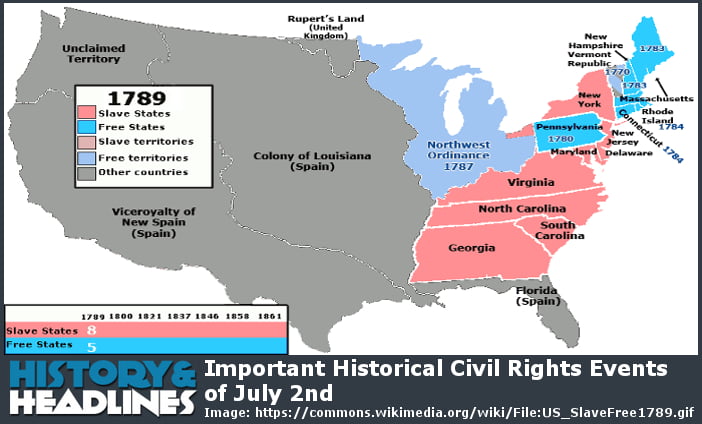
The featured image in this article, a map by Kenmayer of the states and territories of the United States as it was from March 1789 to August 1789 showing which areas of the United States did and did not allow slavery, is licensed under the Creative Commons Attribution-Share Alike 3.0 Unported license.
You can also watch a video version of this article on YouTube: