

A Brief History
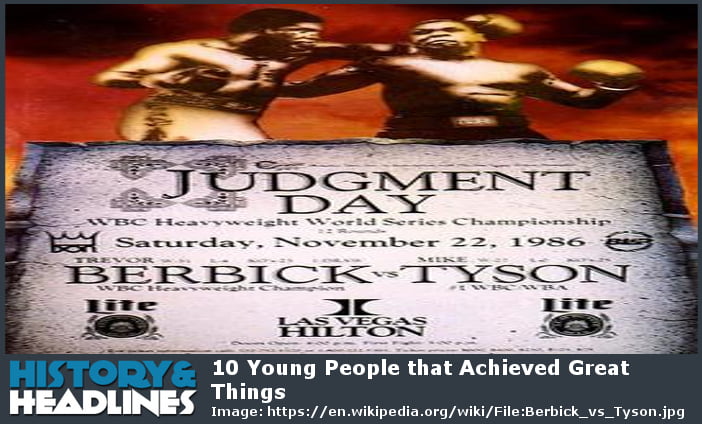
On November 22, 1986, boxer Mike Tyson won the Heavyweight boxing championship at the record young age of 20 years old. Incredibly, Puerto Rican Welterweight boxer won his first championship when only 17! Young people have often achieved great things throughout history, and today we look at 10 of these talented young people. (We will ignore people that inherited their crowns and stick to those that earned their achievements.)
Digging Deeper
1. Wilfred Benitez, 17, professional boxing champion.
Not only did this prodigy win a world title at the age of 17, he went on to win professional boxing championships in 3 different weight classes, including Light Welterweight, Welterweight, and Light Middleweight. Benitez finished his career with a record of 53 wins, 8 losses and 1 draw at the age of 32 in 1990, an already worn out fighter. He is, of course, an inductee to the International Boxing Hall of Fame.
2. Vinnie Ream, 18, sculptor.
On July 28, 1866, Vinnie (Lavinia) Ream, an 18 year old girl became the first woman in the United States to win a commission for a statue, that of the recently deceased President Lincoln. This statue became her most famous work, and it resides in the Rotunda of the US Capitol.
3. Theodore Roosevelt, 42, President of the United States.
Better known as “Teddy” Roosevelt, the Bully-Bully guy ascended to the Presidency on September 14, 1901, due to the assassination of President William McKinley. Roosevelt had been previously elected as McKinley’s running mate for Vice President in 1900. Roosevelt was definitely a go-getter, having served as Governor of New York and Assistant Secretary of the Navy prior to being elected Vice President. He went on to get elected President on his own in 1904, but chose not to run in 1908. By 1912, TR decided to once again run for the White House but lost in a 3 way race to Woodrow Wilson. He was a graduate of Harvard University and the Columbia School of Law (JD). He achieved national fame for his role leading “The Rough Riders” in the fighting in Cuba during the Spanish American War. (Note: John F. Kennedy was the youngest person elected President of the United States in 1960, at the age of 43.) The age of 42 might not seem all that young, until you realize the current President is 73 years old and his main potential Democratic rival for 2020 is Joe Biden, age 77!
4. Marjorie Gestring, 13, Olympic diving Gold Medalist.
The 1936 Berlin Summer Olympics are best known for being a political statement by German leader Adolf Hitler, and the dramatic statement to the contrary made by American Jesse Owens, who won 4 Olympic Gold Medals in track and field. Lost in the glitter was the performance of American diver Marjorie Gestring, not even 14 years old, who dominated and won the 3 Meter Springboard diving competition, becoming the youngest ever Olympic Gold Medalist. The onset of World War II meant the cancellation of the Olympic Games for 1940 and 1944, derailing the Olympic careers of Gestring and many other young athletes.
5. Greta Thunberg, 15, Climate Change activist.
This Swedish teenager made international news in 2018 by addressing the United Nations Climate Change Conference, giving a school child’s viewpoint on the subject of climate change (aka, Global Warming). In 2019, she traveled to the United States on a wind driven sailing yacht to address climate change for a North American audience, including the UN Climate Action Summit as well as other events in Canada and the United States. She was still only 16 years old. In May of 2019 she appeared on the cover of Time Magazine.
6. William Charles Cole Claiborne, 22, member of the US Congress.
In 2019, the national news media treats Alexandria Ocasio-Cortez, age 29 (when she took office), as if she were a mere child, a precocious pixie that somehow found her way into the halls of Congress as a Representative from the State of New York. But we have to go back to 1797 to find our youngest ever elected member of Congress, when Claiborne was elected to represent the people of Tennessee. Incredibly (imagine this scenario today!), the United States had a minimum age for someone to be a Congressman, age 25, which of course Claiborne did not meet. Congress made an exception and allowed him to be seated and made another exception for him at the age of 24 when he was reelected! Since the minimum age of 25 years still stands, it is unlikely Claiborne’s record will be beaten any time soon.
7. Michael Kearney, 10, college graduate.
It seems as if every so often we hear or read of a child prodigy that has either been accepted to a college or university at a very young age or has just graduated from a school of higher learning, but a college grad at age 10? That is what Michael Kearney accomplished in 1994, graduating from The University of South Alabama with a degree in anthropology. Homeschooled as a very young boy, Kearney graduated high school at the age of 6 and junior college at the age of 8. Wow! At the age of 14 he was awarded a Masters degree in Chemistry from Middle Tennessee State University and by the age of 18 had added a Master’s degree in computer science at Vanderbilt University. This prodigy was teaching college classes before he was a licensed driver. Yes, this wunderkind also boasts a PhD, this one in chemistry, earned at the age of 22. (This author was 22 when he earned his BA in Sociology.) Would you be shocked to learn he has won over $1 million in prizes from competing on television game shows?
News Flash: On November 15, 2019, CNN reported a Belgian boy, Laurent Simons, was preparing to graduate from the Eindhoven University of Technology in December of 2019. The young man will get a degree in electrical engineering and plans on immediately starting a post graduate course of study to achieve doctorate degrees in electrical engineering and also in medicine. Doogie Howser look out!
8. Sam Houghton, 5, inventor.
This British lad invented a useful yard tool by holding two different styles of broom together with large rubber bands. Why would he come up with this idea? Because he watched his dear Dad cleaning up the back patio and having to alternate between different styles of broom, a large, coarse one for larger leaves and debris, and a smaller, finer one for smaller bits of debris and dust. The boy realized combining the brooms could save time and effort. It probably does not hurt that the lad’s father is a patent attorney who wanted to teach the boy about how ideas are turned into patents, even though marketing the device is not likely. Sam actually came up with the idea at the age of 3, but bureaucratic processes take time (or so we have heard…). Perhaps a more practical invention by a pre-teen is the popsicle, invented by 11 year old Frank Epperson in 1905, by accident. The lad left his powdered flavor and water concoction (drink) outside on a cold night with a spoon in the glass, and… the next morning he had an icy treat on a stick (spoon) that resembled what we think of as a “popsicle.” He called his invention an “Epsicle,” and though he continued to make the treats, including for his own children when he got older, the kids calling the signature treat “Pop’s Sicle.” The treat was not marketed until 1923.
9. George Westinghouse, 19, inventor.
Perhaps you have owned an appliance with the “Westinghouse” brand name in the past, or even now, but do you know the background of this inventive person? Born in 1846 in Central Bridge, New York, George enlisted in the New York National Guard at the age of 15 (shortly after the American Civil War started) and then served in the Union Army and the Union Navy during the War. After the War, he soon tired of college and dropped out, turning to his main love, inventing. His first patent came when he was only 19 years old, and it was a clue of the myriad of important inventions to come. He came up with a rotary steam engine at the age of 19 and quickly followed with a host of great industrial ideas that revolutionized rail travel among other industries. At the age of 22 he had invented efficient brakes powered by compressed air, which made railroad travel and transport enormously safer, allowing trains to have all their cars brake simultaneously instead of having brakemen applying brakes to cars individually. Later, when George was no longer “young,” he was still a powerhouse in the field of inventing and innovation, siding with Nikola Tesla and A/C electric current against Thomas Edison and D/C electric current in the infamous “Current War” that decided the future of how Americans (and the world) used electricity. Other great teenaged inventors include Louis Braille, a 15 year old French lad that invented the Braille method of reading for blind people, Alexander Graham Bell, who invented the telephone at the age of 18, and Philo Farnsworth, an Idaho teen that had already sketched what would become the television at the age of only 14. Farnsworth, born in 1906, managed to produce a working model of his idea by the age of 21 in 1927.
10. Wolfgang Amadeus Mozart, 5, composer.
Perhaps the most incredible musical prodigy of all time, Mozart showed his musical talent by the age of 3 when he began playing musical instruments, turning to writing his own music by the age of 5 and performing it in front of royalty. A bit of controversy about his first composition; he may have only been 4 years old when he composed the works! Mozart had an older sister (5 years his senior) that was also a musical prodigy, and the children toured Europe together as child prodigies. Mozart landed a position at the Salzburg Royal Court at the age of 16 or 17. During his few years, Mozart compiled an incredible life’s work of fantastic musical compositions, some of the most beautiful music ever composed (according to moi). Sadly, he died at the age of 35 in 1791, with the cause of death not definitively known, perhaps some sort of fever or infection. Musicians seem to be born, not made, and many examples of musical prodigies exist. A modern example could be Michael Jackson, a child star that went on to the top of the pop music scene before his own untimely death at the age of 50.
Question for students (and subscribers) to ponder: Who would you add to this list?
If you liked this article and would like to receive notification of new articles, please feel welcome to subscribe to History and Headlines by liking us on Facebook and becoming one of our patrons!
Your readership is much appreciated!
Historical Evidence
For more information, please see…
Feldman, Howard. Nature’s Gambit : Child Prodigies and the Development of Human Potential. Basic Books, 1986.
Hulbert, Ann. Off the Charts: The Hidden Lives and Lessons of American Child Prodigies. Vintage, 2019.
Tucker, Tom. Brainstorm!: The Stories of Twenty American Kid Inventors. Square Fish, 1998.
The featured image in this article, a scaled-down, low-resolution image of a sports event poster publicizing the Berbick-Tyson professional boxing match on November 22, 1986, is used in an article on a site used for educational purposes hosted on servers in the United States per fair use under the copyright law of the United States.